February 27, 2014

Do You Need a Crown on a Cracked Tooth?

Author

Dr. Charles Payet

Update First Last in Content -> Business Text -> First Last field

Date

February 27, 2014

Share

We recently had a new patient see us with no tooth complaints, she just needed a check up and wanted to discuss her headaches to see if we could help. During her exam, I noticed that several of her molars were severely worn down (which she already knew about) and had cracks visible. We didn’t take photos at her appointment (should have!) to show her, but she seemed comfortable with my recommendation of doing crowns on those 4 teeth to catch and contain the cracks before the teeth break. Since she decided on a second opinion for those teeth, which I fully respect, I decided this is a good opportunity to review cracks in teeth, and what (if anything) to do about them.

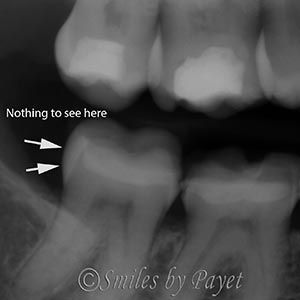
Tooth Cracks Don’t Show Up on X-Rays

Dental X-ray showing teeth with text

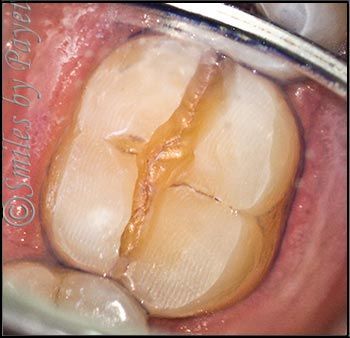
One difficulty with diagnosing cracks in teeth, is that they almost never show up on x-rays. Why, you ask? Good question! It’s because x-rays are traveling perpendicular to the cracks, and the cracks are so narrow, there’s not enough change in the tooth density for the x-rays to show it. To show up on an x-ray, a crack in a tooth would have to be so wide, you could stick a fork in it, and then you’d already know there was a problem. The x-ray shown here is from another patient we recently treated, and while you can’t see anything on the x-ray, want until you see how it looked inside the tooth (on below).


This means we have to identify cracks with our eyes, and hopefully with magnification, because teeth are pretty small to start, and cracks are even smaller. That’s one reason we use dental microscopes in our office. But how do we know which cracks are worrisome, and which aren’t? The biggest problem is that – even if we can see them with our eyes, there’s no predictable way to see how deep they go, especially if there is already a filling in the tooth, as you’ll see in the following examples.amic x-ray. It looks like this:

Teeth Worn Down by Grinding Can Have Deep Cracks

Close-up view of a tooth with a deep crack in the grooves. Amber/brown discoloration.

People who clench or grind their teeth are at a high risk for teeth cracking. Enamel is a crystalline matrix, which means it acts a lot like porcelain (actually, that’s one reason we use porcelain for dental crowns). The longer your grind or clench your teeth, the more you stress that matrix, and eventually a crack starts forming. You’ve probably seen a plate or glass with a crack in it that seems to stay that way for a while, right? But then one day, it suddenly breaks, sometimes for no apparent reason. Well, that’s a pretty good analogy – cracked teeth can stay that way for a long time, but when they go, they go big-time, and sometimes the tooth is a goner, like this one from 10 years ago.

Three Cracked Teeth: 1 Crown and 2 Dental Fillings

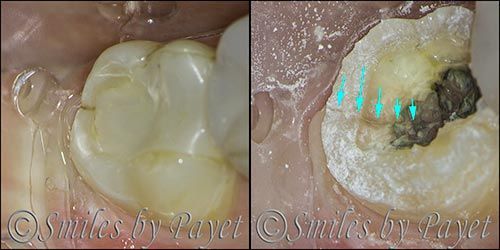
So here’s our patient from yesterday, who’s teeth are a perfect example of what I see all the time (I have more than 3,000 photos of teeth with cracks, taken over the last 12+ years). As you look at the first case, which is getting a crown, you can see how worn down the tooth and old filling are. I’ve highlighted the deep crack with arrows so you can see how far it goes into the tooth – very close to the nerve!

Dental images showing a healthy tooth and a tooth with decay. The decayed tooth has a large cavity.

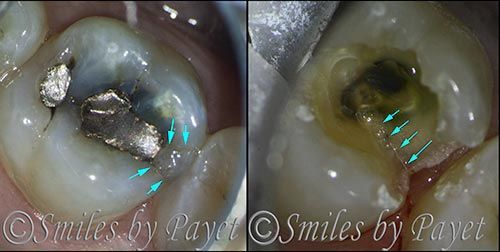
The next 2 teeth both got fillings, but the first one could easily turn into a crown, too, because that crack went way up the side of the tooth. If she has any pain on biting, she knows she’ll need a crown. I felt there was enough strong, healthy tooth structure that a bonded tooth-colored filling to try that first. BTW – see all that dark “halo” around the old filling? That was a lot of decay from bacteria that worked their way around the filling. That’s part of the problem, too: while cracks look small to us, to bacteria they’re like a 4-lane highway. When I see a “double-crack” on the side of a tooth, I pretty much know there’s a cavity, too, just like here.

Two dental photos: tooth with old silver filling and decay; second photo shows cavity after removal.

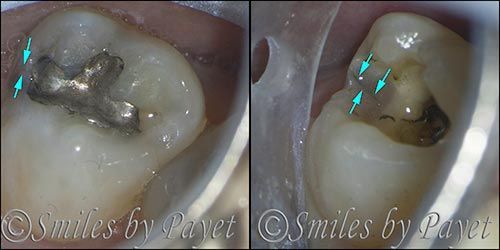
The last tooth (right next to this last one) had a much smaller crack that didn’t go nearly as deep into the tooth. This tooth will do just fine with a bonded filling.

Two dental images: tooth with silver filling and a tooth with a dark area, both marked with arrows.

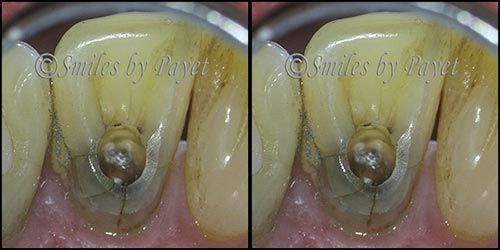
And just to show that front teeth can crack, too, although this was on a different patient.

Close-up of a tooth with a dental preparation, showing the inside. Yellowish color.

Wear a Nightguard to Prevent More Cracks

Certainly we always stress prevention over fixing things, so if you’ve been told you have cracks in your teeth, you should seriously consider a nightguard to take the stress off your teeth at night. I know that many people don’t believe they grind their teeth at night, but when you’re sound asleep, how would you know, right? Some people make noise, some don’t; some have sore jaws, others don’t – it varies a lot. But the simple act of wearing a nightguard will decrease the stress on your teeth and fillings, so they’ll all last longer with fewer problems. And look……..if your dentist tries to tell you how to save money, why wouldn’t you listen? LOL I promise, I make a lot LESS money on a nightguard than on fillings and crowns.


If you’re worried about cracked teeth, call us 704-364-7069 or Contact us for a Comprehensive or Emergency Exam. 


We’ll look forward to meeting you soon!


September 11, 2026
Wondering if dental cavities always hurt? Call our dentists today to learn more about the process of filling your cavities!
September 11, 2026
As I discussed in my last post about Cosmetic Dentistry: Invisalign and a Dental Implant, you don’t always need teeth whitening or porcelain veneers to make a smile more beautiful, nor does it have super expensive, take a long time, or require drilling on your teeth. Sometimes, cosmetic dentistry can be as simple as fixing a gummy smile with laser gum therapy services. Gummy Smiles Don’t Need Veneers – They Need Less Gums! This is honestly one of my favorite kinds of cosmetic dental treatment, but it’s one that many dentists aren’t aware can be done so easily. I wrote about another one of our patients, who still comes in for her check-ups every 6 months like clockwork for the last 5 years), and her Cosmetic Gum Lift, back in 2009. She still can’t believe just how much of a difference it made, and this young lady now feels much the same way. To be completely honest, the change in Tiara’s smile could have been even bigger, but to do so would have required major jaw surgery, and that isn’t something she wanted. But she has been unhappy with her smile for so long, and it’s easy to understand why, right? So what we did is called a “Esthetic Crown Lengthening,” or in normal English, a “gum lift.” Basically, this involves using a laser to recontour the gums (remove the excess) up to the level they should be, and then to gently lift the gums to allow removal of the excess bone that was also covering her teeth. The second part isn’t always necessary, because there’s not always extra bone, but when there is, it’s easy-to-do and painless, because the bone has no nerve endings. A New Smile Fast This photo was taken just 10 days after Tiara’s Gum Lift Procedure, and look what a huge difference it made! She was just ecstatic and couldn’t stop thanking us and smiling. We all know that it’s still not perfect, but she’s not interested in the jaw surgery. But what it is, is a HUGE improvement, don’t you agree?
September 3, 2026
Discover why "soft teeth" is a myth and learn what really causes frequent cavities, from acid reflux to sodas, with insights from a dentist.
September 2, 2026
Learn how dentists view the safety and benefits of fluoride, debunk common myths, and understand the updated guidelines for children's dental care.
August 31, 2026
A dentist critiques a flawed Newsweek article linking water fluoridation to ADHD, explaining the difference between correlation and causation in research.
August 27, 2026
Are juicing, fruit juices, and energy drinks worse than soda? Learn how dentists explain their effects on your teeth and ways to protect your oral health.
August 26, 2026
Curious about TMD, TMJ, migraines, and more? Discover how a dentist separates fact from myth to help you better understand symptoms, causes, and treatments.
August 25, 2026
Do you know how to tell if you need your wisdom teeth removed? Keep reading to learn how a dentist can evaluate your needs and determine if removal is best.
Invisalign
August 24, 2026
Transforming your smile with clear aligners offers a comfortable, flexible, and discreet path. Here are the benefits of using Invisalign. Keep reading!
local cosmetic dentists
August 21, 2026
Learn how local cosmetic dentists correct minor imperfections and revamp damaged teeth. Read our full article to see what smile restoration can do.
Show More