
April 25, 2016

Dental Cavities: How Fast Can They Grow?

Author

Dr. Charles Payet

Update First Last in Content -> Business Text -> First Last field

Date

April 25, 2016

Share

How fast dental cavities grow may sound like a simple question, but it’s actually rather complicated.  I decided to write about it, though, after seeing a patient recently to treat a cavity that went from just beginning to an almost-root-canal-sized cavity in just 14 months.  It’s a good example of why most dentists still recommend dental bitewing x-rays every 12-18 months.

Is the Cavity There or Not?

Dental X-ray showing upper and lower molars, potential cavity highlighted with a question mark.

Here’s the starting x-ray, taken on Dec. 14, 2014 .  If you look at the circled area, it looks fairly normal.  Unfortunately, there was a slight overlap of the teeth in the x-ray, as the digital sensor was angled ever-so-slightly, and the overlap may have masked the area of concern, preventing an earlier diagnosis.  Since the patient had few fillings, though, indicated a low risk of cavities overall, we didn’t retake the x-ray to avoid unnecessary exposure.  Nevertheless, there’s really nothing there that caused me any concern.

14 Months Later, the Cavity is Obvious & Deep

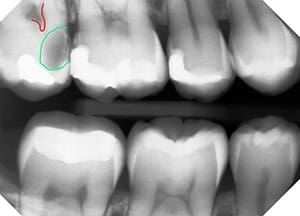
Dental X-ray showing upper and lower molars. A green circle outlines a suspected cyst near the upper left molar.

Check out the circled area this time, eh?  I’ve outlined the nerve chamber in the tooth on the x-ray in red and the cavity in green, but it’s important to know that a cavity is never sharply defined like this.  There are several zones identifiable in cavities, highlighted in the next image.  We also know that cavities are typically about 20-30% bigger than can be seen on an x-ray, which is due to 2 reasons:

  1. The human eye can only distinguish about 60% of the shades of grey as a computer monitor can project, so there is simply detail that the eye can’t detect, and
  2. The deepest zone of decay has not yet softened enough to be less dense enough for x-rays to detect it, as dental x-rays are all about levels of density.  Darker black areas mean it’s extremely soft and x-rays go right through without being blocked, while bright white areas indicate that x-rays are being completely stopped.

Dental Cavities Aren’t Always Obvious from the Outside

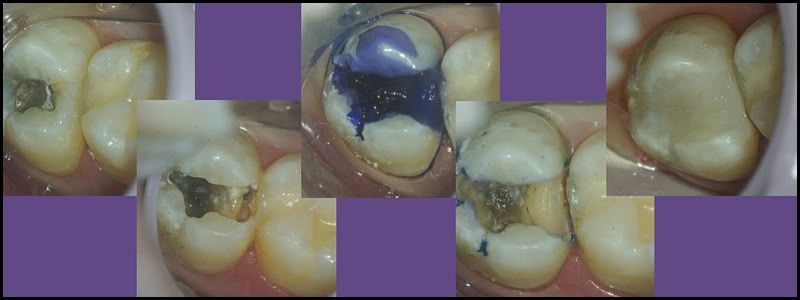
In this short series of photos, taken through our Leica Dental Operating Microscopes at 8.5x magnification, you can see the progression as I clean out the cavity.  On the surface, you can’t even tell something is wrong, can you?  But once the tooth is opened up, the mushiness is obvious.  And when you see how deep the final cavity is, hopefully it also makes sense why dentists tell you that it’s impossible to heal, or reverse, deep cavities, especially with diet.

Dental images: teeth with fillings, a tooth with blue dye, and a completed filling.

Not All Dental Cavities Grow Fast.  What are the Differences?

As it turns out, there was a good reason that this patient’s cavity grew as fast as it did: the patient had developed a habit of sucking on cough drops due to dry air in his workplace making him cough.  He would place the cough drop between his cheek and the upper right molars, and since they weren’t sugar-free cough drops, the long-term sugar exposure in that one area provided the bacteria  all the food supply needed to grow rapidly.  Obviously, not all cavities will progress at this rate.  Sometimes they will progress incredibly slowly , taking years to even break through the enamel and require fixing.  If they haven’t broken through the enamel, they might even reverse.  Cavities as deep as illustrated, though, can never reverse.  They have to be fixed.

Does Everyone Need Dental X-rays Annually?

Most definitely not!  While many dentists find it easiest to maintain all their patients on annual bitewing x-rays for consistency (and there’s really nothing wrong with that, as the level of x-ray exposure from dental x-rays is unbelievably small), this is no longer the ADA’s or FDA’s recommendation.  In 2012, these organizations developed new guidelines for dental x-rays;  while the ultimate decision is still up to the treating doctor, the recommendations allow more flexibility in extending the interval between x-rays, depending on various conditions.  The guidelines generally group people into one of three categories, with the corresponding recommended frequencies (these are all for teens and adults; I’ll cover recommendations for kids in an upcoming article) :

  • New Patients (teens and adults)
    • Selected x-rays to visualize areas where decay is most likely to occur.
      • This usually includes bitewing x-rays for the back teeth and 2-4 periapical x-rays of the front teeth
      • Patients previously or currently diagnosed with periodontal (gum) disease should have a full-mouth series (10-18 x-rays to cover all teeth)
  • Current Patient (teens & adults) with HIGH Risk or CONTINUING Risk of Dental Cavities
    • Selected x-rays every 6-12 months of all areas where decay has recently occurred or is likely to occur
  • Current Patient with LOW Risk of Dental Cavities
    • Routine bitewing x-rays every 18-36 months
      • Quite frankly, the large majority of dentists disagree with 18 months being the routine interval, for the very reason illustrated in this article.
      • In our office, we are moving a number of patients to 18-24 month intervals, but every 3 years?  Sorry, I’m simply not comfortable with that, because so much can change in 3 years.  I don’t actually know of any dentists who do allow up to 3 years between x-rays, although there may be some out there.

To make an appointment for a Complimentary Consultation: call us 704-364-7069 or contact us . We’ll look forward to meeting you soon!

September 11, 2026
Wondering if dental cavities always hurt? Call our dentists today to learn more about the process of filling your cavities!
September 11, 2026
As I discussed in my last post about Cosmetic Dentistry: Invisalign and a Dental Implant, you don’t always need teeth whitening or porcelain veneers to make a smile more beautiful, nor does it have super expensive, take a long time, or require drilling on your teeth. Sometimes, cosmetic dentistry can be as simple as fixing a gummy smile with laser gum therapy services. Gummy Smiles Don’t Need Veneers – They Need Less Gums! This is honestly one of my favorite kinds of cosmetic dental treatment, but it’s one that many dentists aren’t aware can be done so easily. I wrote about another one of our patients, who still comes in for her check-ups every 6 months like clockwork for the last 5 years), and her Cosmetic Gum Lift, back in 2009. She still can’t believe just how much of a difference it made, and this young lady now feels much the same way. To be completely honest, the change in Tiara’s smile could have been even bigger, but to do so would have required major jaw surgery, and that isn’t something she wanted. But she has been unhappy with her smile for so long, and it’s easy to understand why, right? So what we did is called a “Esthetic Crown Lengthening,” or in normal English, a “gum lift.” Basically, this involves using a laser to recontour the gums (remove the excess) up to the level they should be, and then to gently lift the gums to allow removal of the excess bone that was also covering her teeth. The second part isn’t always necessary, because there’s not always extra bone, but when there is, it’s easy-to-do and painless, because the bone has no nerve endings. A New Smile Fast This photo was taken just 10 days after Tiara’s Gum Lift Procedure, and look what a huge difference it made! She was just ecstatic and couldn’t stop thanking us and smiling. We all know that it’s still not perfect, but she’s not interested in the jaw surgery. But what it is, is a HUGE improvement, don’t you agree?
September 3, 2026
Discover why "soft teeth" is a myth and learn what really causes frequent cavities, from acid reflux to sodas, with insights from a dentist.
September 2, 2026
Learn how dentists view the safety and benefits of fluoride, debunk common myths, and understand the updated guidelines for children's dental care.
August 31, 2026
A dentist critiques a flawed Newsweek article linking water fluoridation to ADHD, explaining the difference between correlation and causation in research.
August 27, 2026
Are juicing, fruit juices, and energy drinks worse than soda? Learn how dentists explain their effects on your teeth and ways to protect your oral health.
August 26, 2026
Curious about TMD, TMJ, migraines, and more? Discover how a dentist separates fact from myth to help you better understand symptoms, causes, and treatments.
August 25, 2026
Do you know how to tell if you need your wisdom teeth removed? Keep reading to learn how a dentist can evaluate your needs and determine if removal is best.
Invisalign
August 24, 2026
Transforming your smile with clear aligners offers a comfortable, flexible, and discreet path. Here are the benefits of using Invisalign. Keep reading!
local cosmetic dentists
August 21, 2026
Learn how local cosmetic dentists correct minor imperfections and revamp damaged teeth. Read our full article to see what smile restoration can do.
Show More