June 5, 2013

How Do I Know You Grind Your Teeth, Even if You Don’t Believe Me?

Author

Dr. Charles Payet

Update First Last in Content -> Business Text -> First Last field

Date

June 5, 2013

Share

I don’t know why exactly, but patients at my Charlotte dentist office (and all around the country, according to my colleagues) seem to have a problem believing me when I say, “Wow – you grind your teeth really badly.” In fact, the most common response is, “No I don’t!” said with a passion that makes it seem I’m accusing them of killing baby animals. Seriously – and there are a few reasons why people think they’re right and I’m wrong……..even though I’m the doctor. Weird, huh?

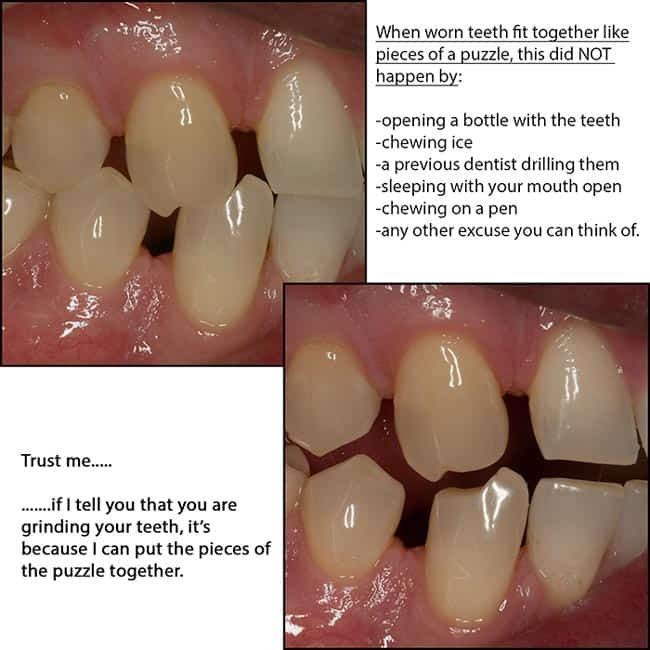
Close-up of worn teeth. Text lists causes: bottle opening, chewing ice/pen, drilling, sleeping open-mouthed.

Reasons People Don’t Think They Grind or Clench Their Teeth

When patients tell me they KNOW they don’t grind their teeth when they sleep, I’m always a little amazed. I mean….how the heck do you know what you do when you’re asleep? Here are some of the reasons people tell me how they know:


  1. My husband/wife/significant other would hear me.
  2. My jaws don’t hurt when I wake up.
  3. My teeth don’t hurt.
  4. I’m a light sleeper.
  5. When I was younger, my dentist ground down my teeth to look like this.
  6. I sleep with my mouth open.
  7. I concentrate on sleeping with my mouth open, and that stops it. (Even better than just sleeping with your mouth open – you CONCENTRATE on it?)
  8. I can’t grind my teeth all night, because I snore all the time.


There are probably a few others that I’ve heard, but these are the most common excuses. However, let me just remind you of one very important fact:


When you are asleep, you don’t have a clue what you’re doing or not, because you’re asleep!


So What Exactly is Bruxism, Anyway?

Let’s get a little information out there so we have a basis for understanding what’s going on, shall we? This is a topic I really enjoy, so I try to stay reasonably up-to-date on current research and am friends with a fair number of internationally-recognized experts in the field. If you want to a more in-depth summary, this Wikipedia article on bruxism is mostly up-to-date.


  • Bruxism is classified as a SLEEP DISORDER. There is still a lot of debate about exact causes.
  • The “bite” has absolutely nothing to do with whether or not you grind your teeth. IOW, it doesn’t matter if your teeth fit together perfectly or all crazy.
  • If you do grind, it only happens in short bursts; it’s not all night.  Each instance may only last for 30 seconds to a minute. You may well sleep with your mouth open 90% of the night (doubtful), but still grind the heck out of your teeth during the 10%.
  • You can clench up to 130% harder at night than during the day, because your protective reflexes are turned off.
  • Clenching and grinding aren’t really the same thing.Teeth Clenching: the teeth squeeze so hard that they can’t move. these patients typically do little damage to their teeth but have much worse pain.
  • Teeth Grinding: the teeth still squeeze hard, but not so hard that they can’t move around. These patients tend to do lots more damage, but actually have less pain.
  • Some people do a mix of both
  • Enamel is 15% harder than your bones; to wear your enamel flat in a lot of places, it takes a LOT of force, a LOT of times, over a LONG period of time. You can’t do it in a couple months.
  • An acidic diet (sodas, foods, etc) weakens your enamel and makes it easier to wear down during bruxism. It’s like a multiplier.
  • Not everybody grinds or clenches the same way, but everyone has a pattern that doesn’t seem to change. One of my colleagues and mentors tracked more than 400 patients over 10 years, and found that – no matter what treatment the patients had (braces, major reconstruction, combination), their bruxing pattern stayed amazingly consistent.

A Nightguard is Cheaper Than a Smile Makeover

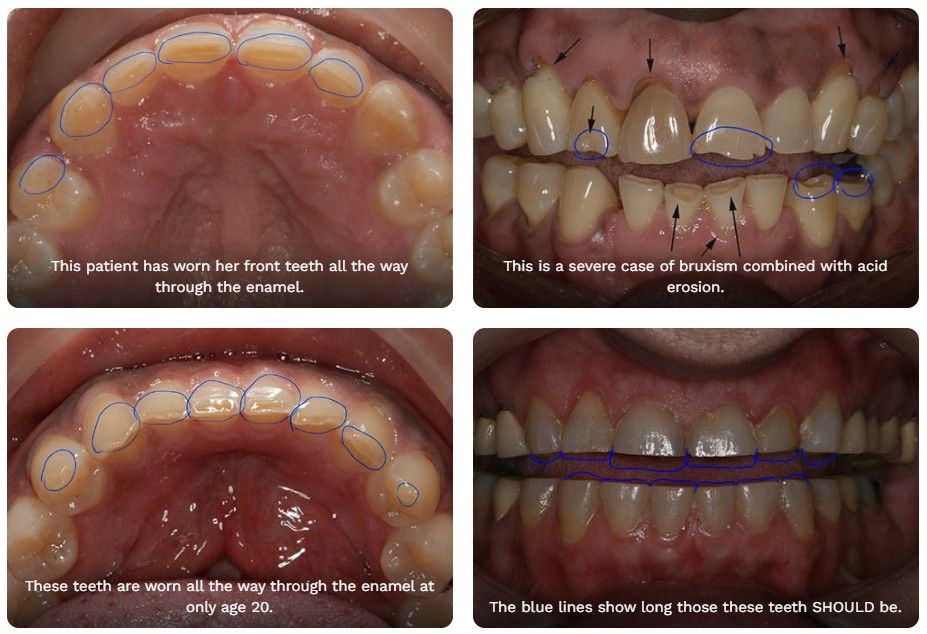
Let’s look at some other examples of how teeth can look when damaged by bruxism (click on any image for a full-screen view). Now bear in mind…..NONE of these patients reported any jaw pain or headaches, and none of them believed that they did this by grinding their teeth, but I promise – there is no other way you can do this!

Four dental photos: teeth with enamel erosion, a mouth guard, and outlined teeth.

Now, looking at those photos, let’s talk about the cost of a nightguard (even a custom-made one by a dentist) vs. what it will cost to fix those teeth:


  • If you get a cheapo, “boil’n’bite” nightguard from the drugstore, it will probably only cost $25 or so. What’s the catch to the cheap option? I’ve never yet known anyone to actually wear one of those more than a week or 2. And if you don’t wear the nightguard, it doesn’t work, so what’s the point?
  • A custom-made nightguard at the dentist, like the NTI-tss Nightguard we recommend, can cost between $500-800; I have many patients wearing theirs now for more than 6 years with only minor repairs.
  • In comparison……a smile makeover for any of the cases in that photo gallery will cost a minimum of $8,000, and potentially up to $40-50,000.

Now……..how expensive is that nightguard, really?

“My Insurance Doesn’t Pay for Nightguards”

OK………so what? News flash – your insurance won’t pay for a smile makeover, either! You tell me – do you want to pay me $5-800 for a nightguard, or do you want to pay me $40-50,000 for a smile makeover? Obviously, I make a lot more money with the smile makeover, but hey, there’s an easy way for you to NOT pay me for it – get the nightguard and wear it! It honestly and truly doesn’t make a difference to me which you choose, because it’s your choice and they’re your teeth. But if I’m telling you how to save tens of thousands of dollars down the road……isn’t it worth considering, even if the nightguard is out of your pocket?


So what do you think? Are you still sure you don’t grind your teeth? Still don’t want to get the nightguard? Or would you like to save time in the dentist’s chair and a lot of money, and let the expert help you avoid all that?


September 11, 2026
Wondering if dental cavities always hurt? Call our dentists today to learn more about the process of filling your cavities!
September 11, 2026
As I discussed in my last post about Cosmetic Dentistry: Invisalign and a Dental Implant, you don’t always need teeth whitening or porcelain veneers to make a smile more beautiful, nor does it have super expensive, take a long time, or require drilling on your teeth. Sometimes, cosmetic dentistry can be as simple as fixing a gummy smile with laser gum therapy services. Gummy Smiles Don’t Need Veneers – They Need Less Gums! This is honestly one of my favorite kinds of cosmetic dental treatment, but it’s one that many dentists aren’t aware can be done so easily. I wrote about another one of our patients, who still comes in for her check-ups every 6 months like clockwork for the last 5 years), and her Cosmetic Gum Lift, back in 2009. She still can’t believe just how much of a difference it made, and this young lady now feels much the same way. To be completely honest, the change in Tiara’s smile could have been even bigger, but to do so would have required major jaw surgery, and that isn’t something she wanted. But she has been unhappy with her smile for so long, and it’s easy to understand why, right? So what we did is called a “Esthetic Crown Lengthening,” or in normal English, a “gum lift.” Basically, this involves using a laser to recontour the gums (remove the excess) up to the level they should be, and then to gently lift the gums to allow removal of the excess bone that was also covering her teeth. The second part isn’t always necessary, because there’s not always extra bone, but when there is, it’s easy-to-do and painless, because the bone has no nerve endings. A New Smile Fast This photo was taken just 10 days after Tiara’s Gum Lift Procedure, and look what a huge difference it made! She was just ecstatic and couldn’t stop thanking us and smiling. We all know that it’s still not perfect, but she’s not interested in the jaw surgery. But what it is, is a HUGE improvement, don’t you agree?
September 3, 2026
Discover why "soft teeth" is a myth and learn what really causes frequent cavities, from acid reflux to sodas, with insights from a dentist.
September 2, 2026
Learn how dentists view the safety and benefits of fluoride, debunk common myths, and understand the updated guidelines for children's dental care.
August 31, 2026
A dentist critiques a flawed Newsweek article linking water fluoridation to ADHD, explaining the difference between correlation and causation in research.
August 27, 2026
Are juicing, fruit juices, and energy drinks worse than soda? Learn how dentists explain their effects on your teeth and ways to protect your oral health.
August 26, 2026
Curious about TMD, TMJ, migraines, and more? Discover how a dentist separates fact from myth to help you better understand symptoms, causes, and treatments.
August 25, 2026
Do you know how to tell if you need your wisdom teeth removed? Keep reading to learn how a dentist can evaluate your needs and determine if removal is best.
Invisalign
August 24, 2026
Transforming your smile with clear aligners offers a comfortable, flexible, and discreet path. Here are the benefits of using Invisalign. Keep reading!
local cosmetic dentists
August 21, 2026
Learn how local cosmetic dentists correct minor imperfections and revamp damaged teeth. Read our full article to see what smile restoration can do.
Show More