

November 9, 2019

Dental X-rays: Why, Which, & When?

Author

Dr. Charles Payet

Update First Last in Content -> Business Text -> First Last field

Date

November 9, 2019

Share

Digital dental x-rays have come a long way in improving our ability to diagnose problems in your teeth and jaws. But which ones do you need, when do you need them, and why do dentists recommend each kind?

Types of Dental X-rays

Periapical X-rays

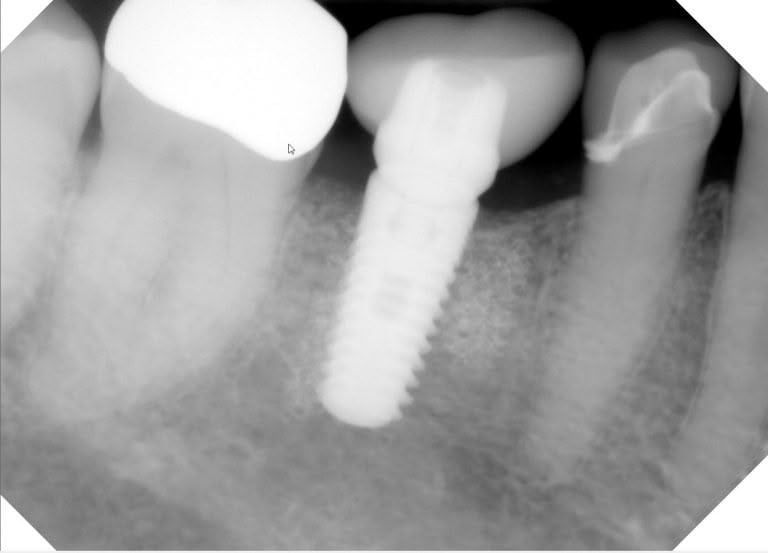
Dental X-ray showing a tooth implant with a crown, and adjacent teeth with fillings.

Periapical x-rays capture the full length of 1 or more teeth, so that we can see the apex, or end, of the root.  That’s where we look for signs of a tooth abscess, or infection. We also use them, as in this case, to make sure that dental implants are fully integrated in the bone.

Bitewing X-rays

These  x-rays of the back teeth are usually taken in groups of 2 or 4, so 1 or 2 per side. Sometimes it may be a group of 7 in a different orientation.  Most people have get them every 12 months to check for cavities between the teeth, where we can’t see them.  If you’ve never had a cavity between your teeth and are at low risk, your dentist might change it to every 18-, 24-, or rarely every 36 months.  Or if you get cavities a lot, your dentist might even recommend them every 6 months. The patient in the below example has gotten a mouthful of dental crowns in her 70+ years. Because we want to catch any cavities around the crowns early, she definitely gets bitewings once a year.

4 bitewing x-rays showing dental crowns, fillings, and a dental implant

Full-Mouth Series

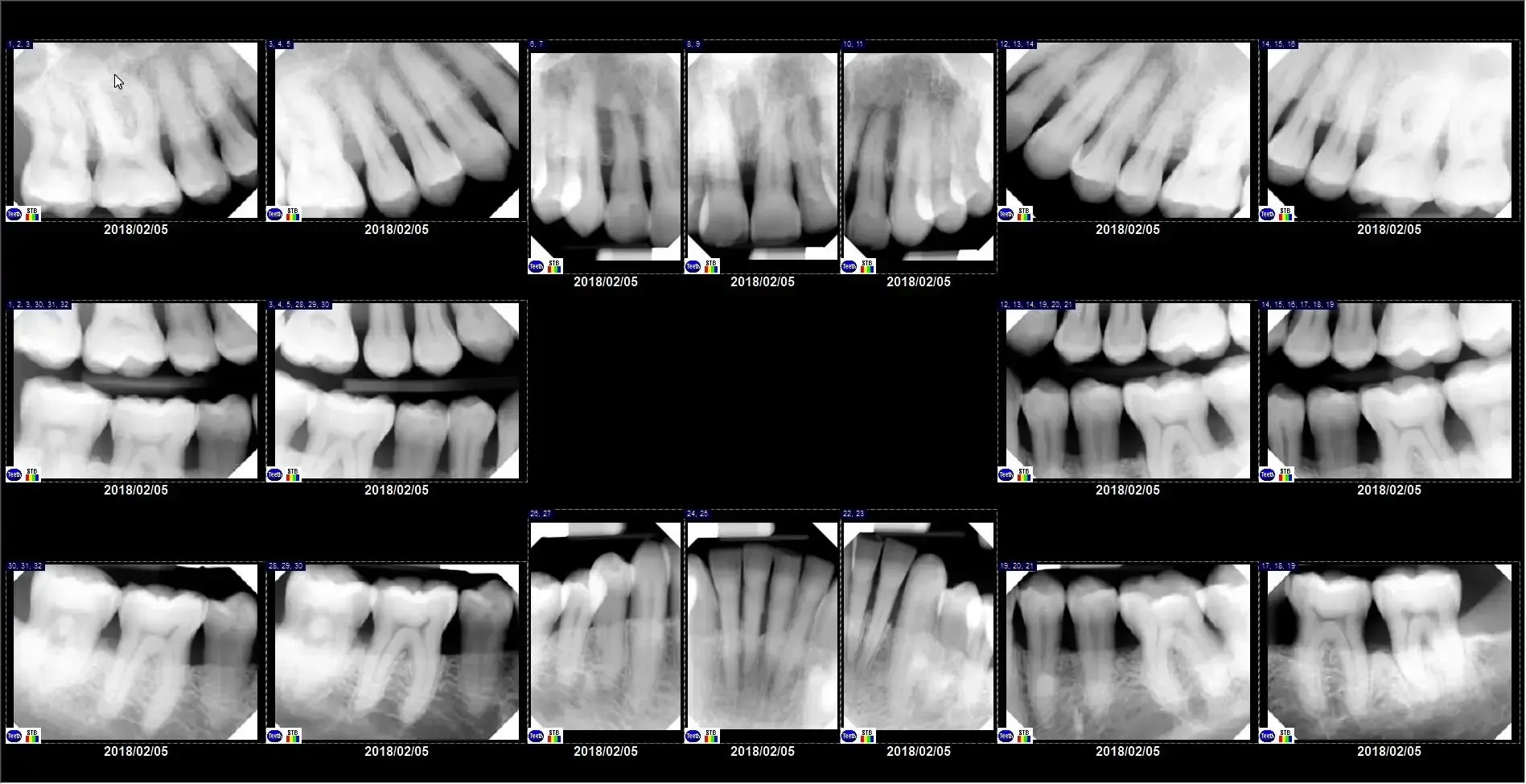
For patients who have cavities on many teeth, or especially if they have gum (periodontal) disease, we take a full-mouth series of x-rays.  This is a minimum of 10 total x-rays, including both bitewings and periapical dental x-rays.

Dental X-ray images, showing various teeth, in a panoramic view.

Panoramic Dental X-rays

The dental x-rays you see below are called panoramic x-rays.  This kind is usually taken ever 3-5 years to screen for possible bone cysts, tumors, sinus abnormalities, etc.  It’s also used to check growth and development in children, to make sure their teeth are developing normally.  The first one shown here, which I labeled, is of a healthy patient.

panoramic x-ray of a healthy patient
A panoramic x-ray, with labels showing anatomy of teeth and jaws

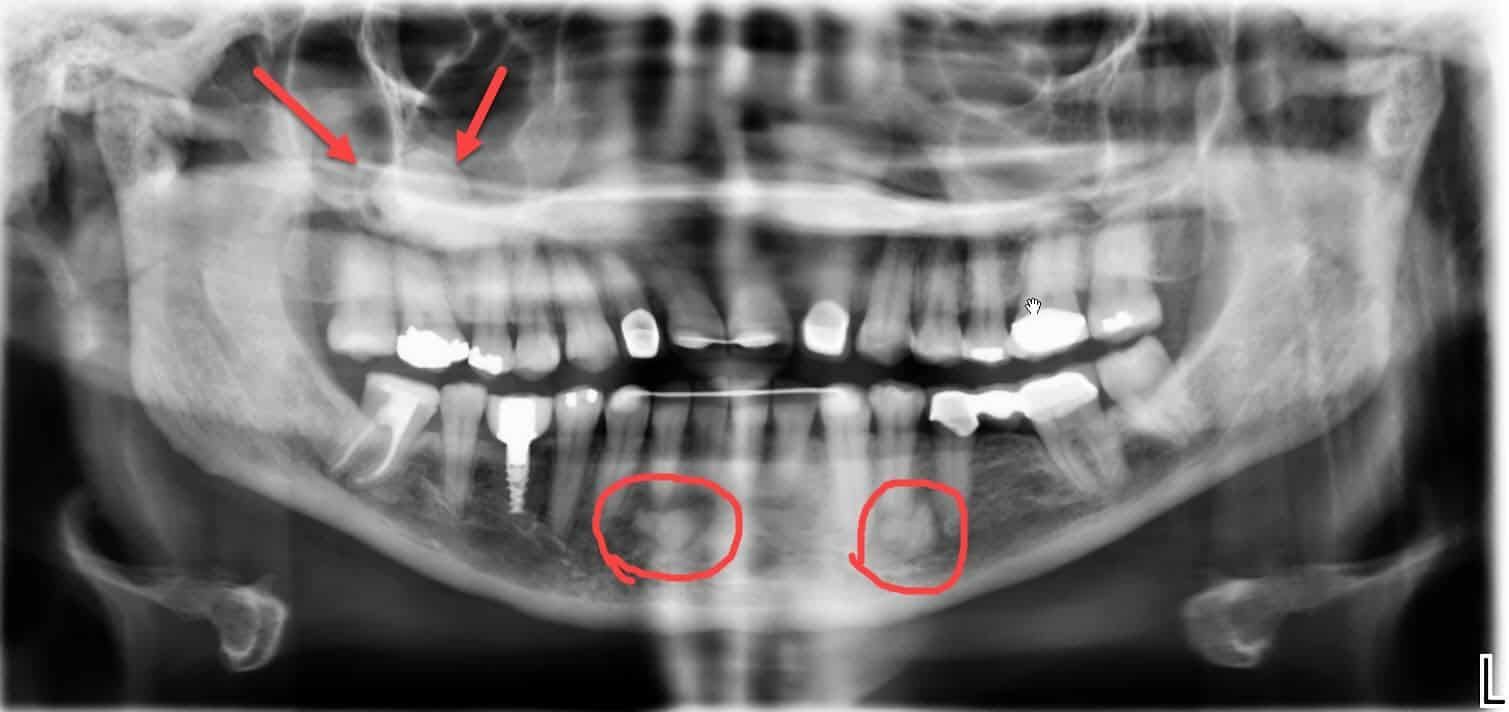
But this panoramic x-ray, taken in the fall of 2019, surprised me with several unusual areas.  There’s a large, dense, circular something in the right sinus, which definitely doesn’t belong there.  There are also 2 irregular areas of unusually dense bone on the lower jaw.  We have sent this patient to an oral surgeon for further evaluation.

panoramic x-ray showing pathology
A panoramic x-ray showing several areas of concern,

Because we wanted more information about those unusual areas, we took another kind of dental x-ray, described next.

Cone Beam X-ray, or CT Scan

When we need a lot more detail, or different perspectives and angles, we take a CT scan, also called a cone beam or 3D x-ray.  Cone beam images are quite different from the other types, because they’re taken in slices.  Computer algorithms turn those slices into a 3D images.  That 3D x-ray can be rotated in every direction, and we can scan through it up/down, forward/back, and side-to-side.  They’re really quite incredible!

These cone beam views are of the same patient above, with the panoramic x-ray.  Now we see the true size and shape of those unusual areas.

cone beam CT scan views
Different views of the jaw with a cone beam x-ray, or CT scan.

3D X-Rays for Dental Implants

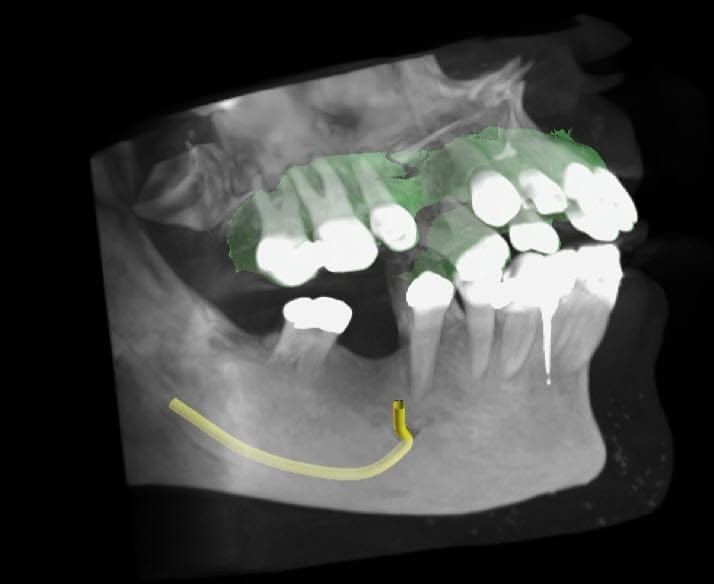
Dental x-ray scan of teeth, with some highlighted in green, and a yellow, tube-like structure in the jaw.

When planning dental implants, we have to know if the bone is both wide and tall enough.  If it is, great!  If not, then you may need a bone graft or sinus lift to build up the bone.  Without the 3D views, we can’t know that.  We can also see other important anatomy, like the big nerve in your lower jaw (the yellow line).   We really don’t want to run into that!

In short, dental x-rays give us critical information about both your teeth and your jaws.  Without them, it’s really impossible for us to do a good job for you.

Call 704-364-7069 or Contact us for a Comprehensive or Emergency Exam. 

It’s that easy to start.

September 11, 2026
Wondering if dental cavities always hurt? Call our dentists today to learn more about the process of filling your cavities!
September 11, 2026
As I discussed in my last post about Cosmetic Dentistry: Invisalign and a Dental Implant, you don’t always need teeth whitening or porcelain veneers to make a smile more beautiful, nor does it have super expensive, take a long time, or require drilling on your teeth. Sometimes, cosmetic dentistry can be as simple as fixing a gummy smile with laser gum therapy services. Gummy Smiles Don’t Need Veneers – They Need Less Gums! This is honestly one of my favorite kinds of cosmetic dental treatment, but it’s one that many dentists aren’t aware can be done so easily. I wrote about another one of our patients, who still comes in for her check-ups every 6 months like clockwork for the last 5 years), and her Cosmetic Gum Lift, back in 2009. She still can’t believe just how much of a difference it made, and this young lady now feels much the same way. To be completely honest, the change in Tiara’s smile could have been even bigger, but to do so would have required major jaw surgery, and that isn’t something she wanted. But she has been unhappy with her smile for so long, and it’s easy to understand why, right? So what we did is called a “Esthetic Crown Lengthening,” or in normal English, a “gum lift.” Basically, this involves using a laser to recontour the gums (remove the excess) up to the level they should be, and then to gently lift the gums to allow removal of the excess bone that was also covering her teeth. The second part isn’t always necessary, because there’s not always extra bone, but when there is, it’s easy-to-do and painless, because the bone has no nerve endings. A New Smile Fast This photo was taken just 10 days after Tiara’s Gum Lift Procedure, and look what a huge difference it made! She was just ecstatic and couldn’t stop thanking us and smiling. We all know that it’s still not perfect, but she’s not interested in the jaw surgery. But what it is, is a HUGE improvement, don’t you agree?
September 3, 2026
Discover why "soft teeth" is a myth and learn what really causes frequent cavities, from acid reflux to sodas, with insights from a dentist.
September 2, 2026
Learn how dentists view the safety and benefits of fluoride, debunk common myths, and understand the updated guidelines for children's dental care.
August 31, 2026
A dentist critiques a flawed Newsweek article linking water fluoridation to ADHD, explaining the difference between correlation and causation in research.
August 27, 2026
Are juicing, fruit juices, and energy drinks worse than soda? Learn how dentists explain their effects on your teeth and ways to protect your oral health.
August 26, 2026
Curious about TMD, TMJ, migraines, and more? Discover how a dentist separates fact from myth to help you better understand symptoms, causes, and treatments.
August 25, 2026
Do you know how to tell if you need your wisdom teeth removed? Keep reading to learn how a dentist can evaluate your needs and determine if removal is best.
Invisalign
August 24, 2026
Transforming your smile with clear aligners offers a comfortable, flexible, and discreet path. Here are the benefits of using Invisalign. Keep reading!
local cosmetic dentists
August 21, 2026
Learn how local cosmetic dentists correct minor imperfections and revamp damaged teeth. Read our full article to see what smile restoration can do.
Show More