August 11, 2019

What is Root Resorption? Can it Be Fixed?

Author

Dr. Charles Payet

Update First Last in Content -> Business Text -> First Last field

Date

August 11, 2019

Share

Root Resorption comes in 2 flavors, so to speak: Internal and External.  It’s one of the least common reasons for losing a tooth, compared to tooth decay and gum disease.  When it is found though, it usually means the tooth is doomed.  But what is root resorption?

Internal & External Root Resorption FAQs

The term “resorption” comes from the Latin root  resorbere , meaning “to absorb.”  In teeth however, it’s not really absorption like a sponge absorbing water.  A tooth being resorbed is actually eaten away , either by cells inside the pulp or outside the root.  Because the growing cells shouldn’t be, resorption is a little like cancer.  Only a little bit though.  That’s because root resorption never spreads, not even to the tooth next to it.

Internal Root Resorption is caused by Pulp Cells

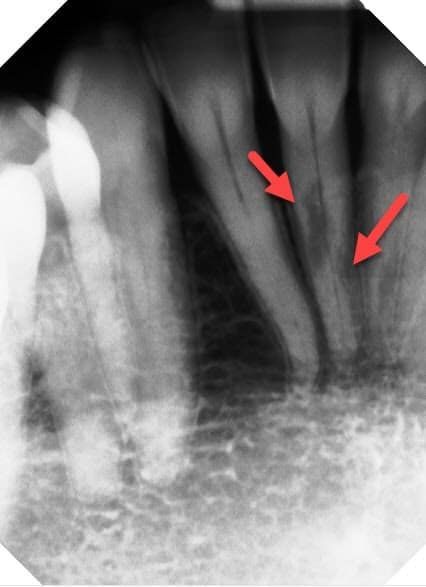
Dental X-ray showing root canals, highlighted by red arrows, revealing possible decay in teeth.

Pulp cells are found in the nerve chamber and canals inside the tooth.  They start growing outward, turning the dentin into a sponge-like, soft, mushy mess.  It’s usually a very slow process, and it’s rarely painful until it has progressed a lot.  Because it usually happens  in tooth roots, it’s often not visible on normal x-rays.  That means dentists can’t see it, unless there’s a reason to take an x-ray of the whole tooth, as seen here.  This was taken in July 2019, on a new patient in our practice.  It became sensitive just recently.

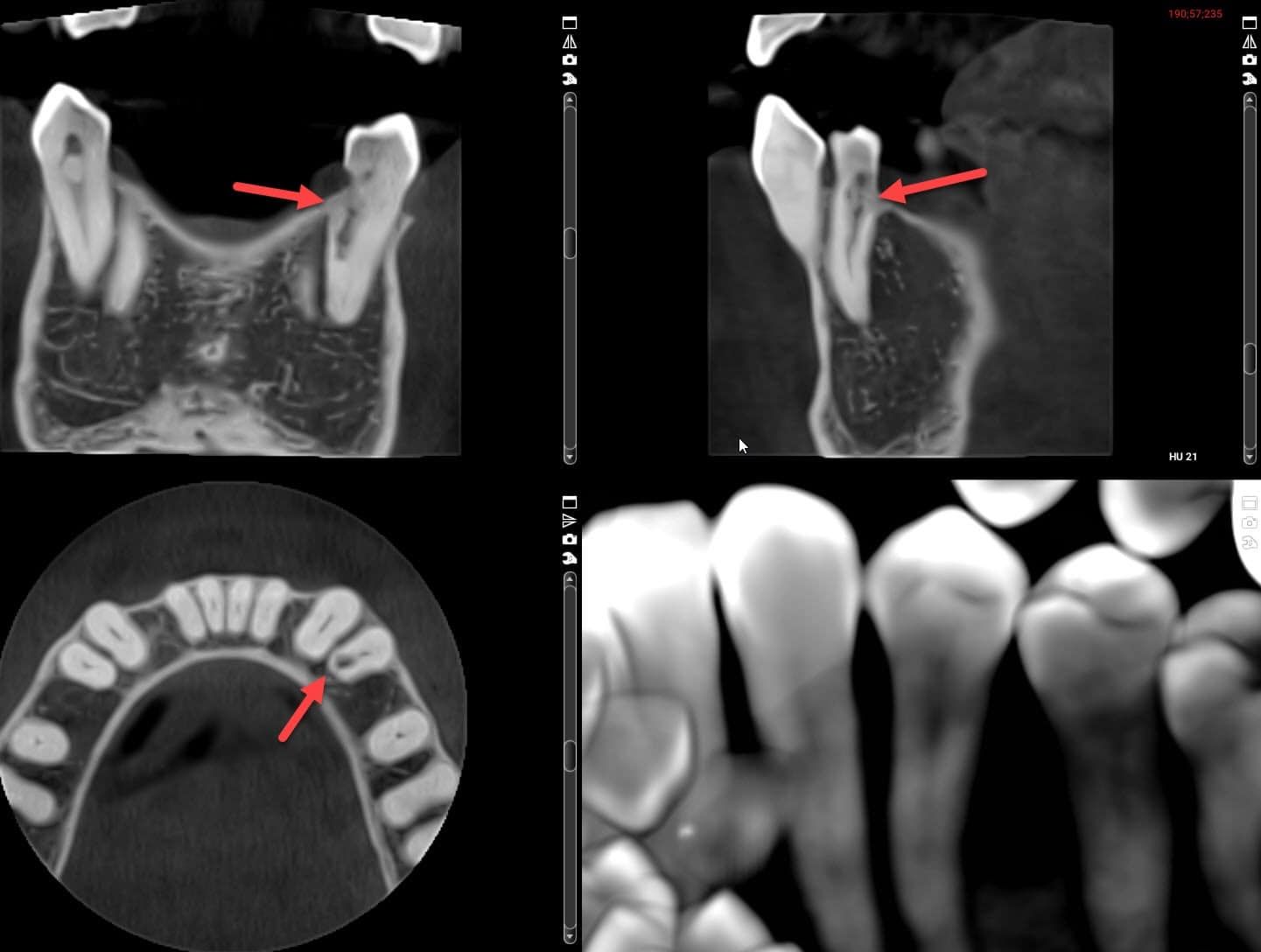
Based on this x-ray alone, I didn’t know if this was internal or external resorption.  So we took a 3D Cone Beam x-ray, to see it from multiple angles, as seen below. From that, it appears to be internal root resorption.  It got big enough to break through the root, which allows bacteria in.  That’s probably why it became sensitive recently.

Dental CT scan showing several views of teeth, highlighted by red arrows, indicating a possible dental issue.

We don’t know yet if this tooth can be saved, but I’ve referred her to a root canal specialist (endodontist) and gum specialist (periodontist).  If they can’t save it, we will probably do a dental bridge to replace the tooth.  The other tooth roots are too close together for a dental implant. I’ll try to remember to update the post once she makes a decision.

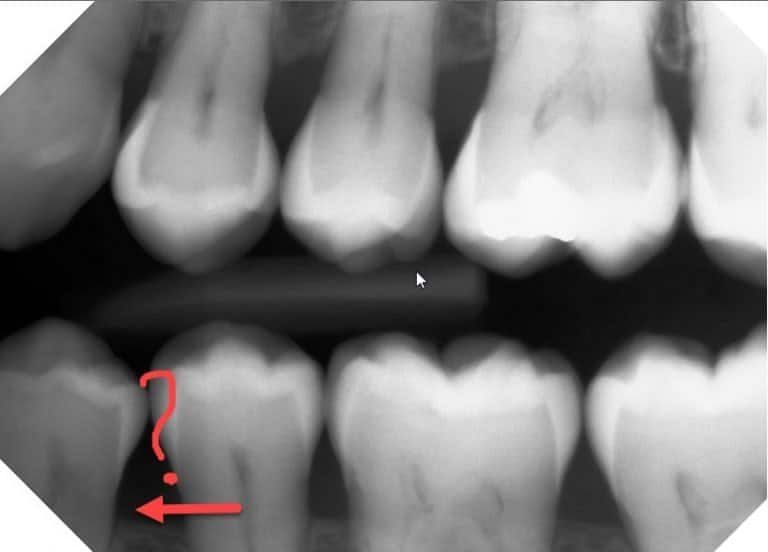
External Root Resorption is caused by Periodontal Ligament Cells

Dental X-ray showing teeth with a red arrow pointing to a possible cavity.

As I mentioned, root resorption is pretty uncommon.  In my 20+ years of practicing dentistry, I’ve only come across a few cases.  That’s why the patient in the first case above was so unusual.  When evaluating the lower front tooth resorption, I noticed a second tooth with resorption, but this time it clearly started outside of the tooth.  2 teeth with resorption on the same patient is odd enough.  One tooth with internal resorption and one tooth with external resorption  on the same patient???   I’ve never seen, nor even heard of that happening.

It’s a good thing we took the 3D Cone Beam x-ray on the patient though, because we couldn’t see it on the regular bite-wing x-ray at all.  This tooth didn’t bother her at all, so we had no reason to suspect it.

Dental CT scan: Multiple views showing a tooth with a root canal infection.

Unfortunately, this tooth is definitely not fixable, so it will be extracted and probably replaced with a dental implant and crown.  Since it isn’t bothering her and isn’t visible in her smile, we’ll wait until the other tooth is finished.

Inflammatory Root Resorption after Braces

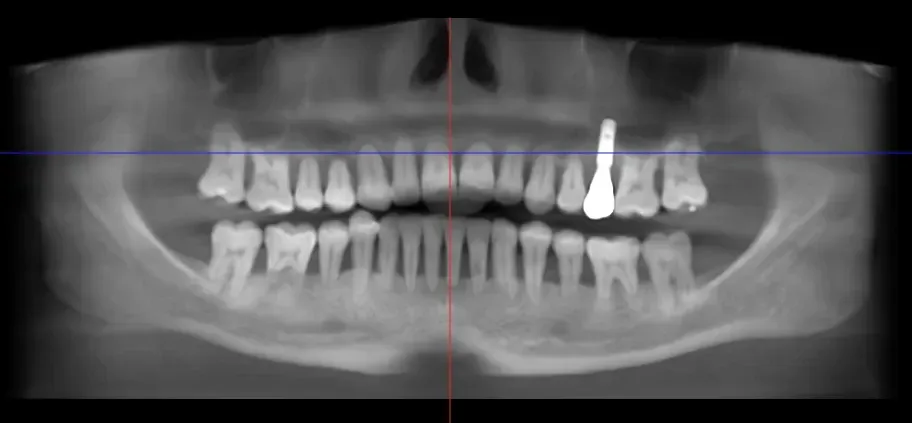
There is one type of root resorption that is unfortunately a bit more uncommon.  This kind occurs after aggressive tooth movement, and it seems to have a partially genetic basis.  This panoramic x-ray is from a long-time patient in our practice.  Her roots have gotten progressively shorter over the years, and now they’re starting to get loose.  It’s tragic, but she will probably lose all her teeth within the next couple years. That’s why we’re discussing implant-supported bridges to replace all her teeth soon.

Panoramic dental X-ray showing teeth and jaw, highlighting a dental implant.

Call us 704-364-7069 or Contact us for a Comprehensive or Emergency Exam. 

It’s that easy to start.

September 11, 2026
Wondering if dental cavities always hurt? Call our dentists today to learn more about the process of filling your cavities!
September 11, 2026
As I discussed in my last post about Cosmetic Dentistry: Invisalign and a Dental Implant, you don’t always need teeth whitening or porcelain veneers to make a smile more beautiful, nor does it have super expensive, take a long time, or require drilling on your teeth. Sometimes, cosmetic dentistry can be as simple as fixing a gummy smile with laser gum therapy services. Gummy Smiles Don’t Need Veneers – They Need Less Gums! This is honestly one of my favorite kinds of cosmetic dental treatment, but it’s one that many dentists aren’t aware can be done so easily. I wrote about another one of our patients, who still comes in for her check-ups every 6 months like clockwork for the last 5 years), and her Cosmetic Gum Lift, back in 2009. She still can’t believe just how much of a difference it made, and this young lady now feels much the same way. To be completely honest, the change in Tiara’s smile could have been even bigger, but to do so would have required major jaw surgery, and that isn’t something she wanted. But she has been unhappy with her smile for so long, and it’s easy to understand why, right? So what we did is called a “Esthetic Crown Lengthening,” or in normal English, a “gum lift.” Basically, this involves using a laser to recontour the gums (remove the excess) up to the level they should be, and then to gently lift the gums to allow removal of the excess bone that was also covering her teeth. The second part isn’t always necessary, because there’s not always extra bone, but when there is, it’s easy-to-do and painless, because the bone has no nerve endings. A New Smile Fast This photo was taken just 10 days after Tiara’s Gum Lift Procedure, and look what a huge difference it made! She was just ecstatic and couldn’t stop thanking us and smiling. We all know that it’s still not perfect, but she’s not interested in the jaw surgery. But what it is, is a HUGE improvement, don’t you agree?
September 3, 2026
Discover why "soft teeth" is a myth and learn what really causes frequent cavities, from acid reflux to sodas, with insights from a dentist.
September 2, 2026
Learn how dentists view the safety and benefits of fluoride, debunk common myths, and understand the updated guidelines for children's dental care.
August 31, 2026
A dentist critiques a flawed Newsweek article linking water fluoridation to ADHD, explaining the difference between correlation and causation in research.
August 27, 2026
Are juicing, fruit juices, and energy drinks worse than soda? Learn how dentists explain their effects on your teeth and ways to protect your oral health.
August 26, 2026
Curious about TMD, TMJ, migraines, and more? Discover how a dentist separates fact from myth to help you better understand symptoms, causes, and treatments.
August 25, 2026
Do you know how to tell if you need your wisdom teeth removed? Keep reading to learn how a dentist can evaluate your needs and determine if removal is best.
Invisalign
August 24, 2026
Transforming your smile with clear aligners offers a comfortable, flexible, and discreet path. Here are the benefits of using Invisalign. Keep reading!
local cosmetic dentists
August 21, 2026
Learn how local cosmetic dentists correct minor imperfections and revamp damaged teeth. Read our full article to see what smile restoration can do.
Show More